Full bus study
F8 · integrated pipeline
Runs short-circuit, coordination, arc-flash and technical consolidation into one auditable report.
3D arc-flash to NBR 17227:2025, CT saturation in the time domain, transients and coordination. Every result ships with its calculation trail, the standard cited and a traceable report — not just a final number.
28+
technical tools
OLV2
online activation
SHA256
auditable release
Institutional video: from the electrical study to the auditable report.
Study tools
From short-circuit to coordination, from arc-flash to CT saturation: every module gives you the path of the calculation, not just the result. That is what lets you defend the study under audit.
F8 · integrated pipeline
Runs short-circuit, coordination, arc-flash and technical consolidation into one auditable report.
IEC 60909-0:2016
Ik'', ip, Ib, Ik, contributing sources and a general per-bus study.
ANSI C37.5 / C37.010
NACD, asymmetric current, multiplying factors and breaker withstand.
IEC / ANSI over time
Fault current over time, AC/DC decrement and asymmetric peak.
IEEE 399 / Stevenson
Voltage profile, losses, loading and the basis for industrial studies.
Seq. 0/1/2 · IEEE 1159
Phase study, positive/negative/zero sequence and unbalanced conditions.
IEEE 242 Buff Book
Relays, breakers, CTs and time-current (TCC) curves in one integrated flow.
IEC 60255 / IEEE C37.112
Time-current curves for relays, fuses, cables, motors and transformers.
NBR 17227 / IEEE 1584
Incident energy, boundaries and report data for electrical safety.
NFPA 70E / NBR 17227
Label designer with technical fields, PPE, working distance and boundaries.
7 arc-flash methods
Technical comparison across normative approaches to incident energy.
IEEE 141 Red Book
Connected load, demand, per-bus loading and sizing basis.
IEEE 399 / IEEE 141
Inrush current, voltage drop, acceleration time and system impact.
IEEE C57.13 / IEC 61869-2
Checks saturation, CT class, secondary burden and fault under-measurement risk.
IEEE 242 / NBR 5410
Assesses interrupting capacity, voltage, current, thermal, coordination and application.
NEC 220 / BR sectors
Demand categories to estimate design load and operating reserve.
NBR 5410 / 14039 / 5422
LV, MV and HV overhead lines with a traceable technical catalog.
NBR 5410 §6.2.7
Per-bus drop, steady state and motor starting against design limits.
IEEE 80
Grounding criteria, safety, touch voltage and step voltage.
HTML / PDF / SHA256
Full report with version traceability, assumptions, responsible engineer and history.
Assistant · AI
Report generation and Q&A based on the study's computed results.
Enterprise · IEEE 399 §10 / IEEE 1668
Assesses energization/de-energization BEFORE the maneuver in the native engine: starting voltage dip, inrush, islanding and a GO/NO-GO verdict.
Enterprise · Ed25519 seal
Reports with a cryptographic seal (integrity + origin) verifiable by third parties, offline or at olivaspss.com/verify. Tamper-proof.
Enterprise · digital twin
Persistent assembly identity with a hash-chained, tamper-evident history (issuance, compliance, FAT, SAT, tests).
Enterprise · IEEE 519 / UL 1561
Harmonic spectrum, input reactor, dv/dt and sine filters, K-factor transformer and derating.
Enterprise · IEEE 519
Frequency scan and parallel-resonance detection when adding capacitor banks and filters.
Enterprise · IEEE 485 / 946
Bank sizing (ampere-hour method), cell count and short-circuit on the DC bus.
Enterprise · IEC 61439 / FAT-SAT
Assembly compliance (Icw/Ipk/RDF), forms of separation, commissioning checklist and relay testing (ANSI C37.2).
Featured study
Incident energy is not a single number — it changes with distance, arc height and enclosure geometry. Olivas solves the field in three dimensions and draws the iso-energy shells: you see how far each level reaches instead of trusting a table value.
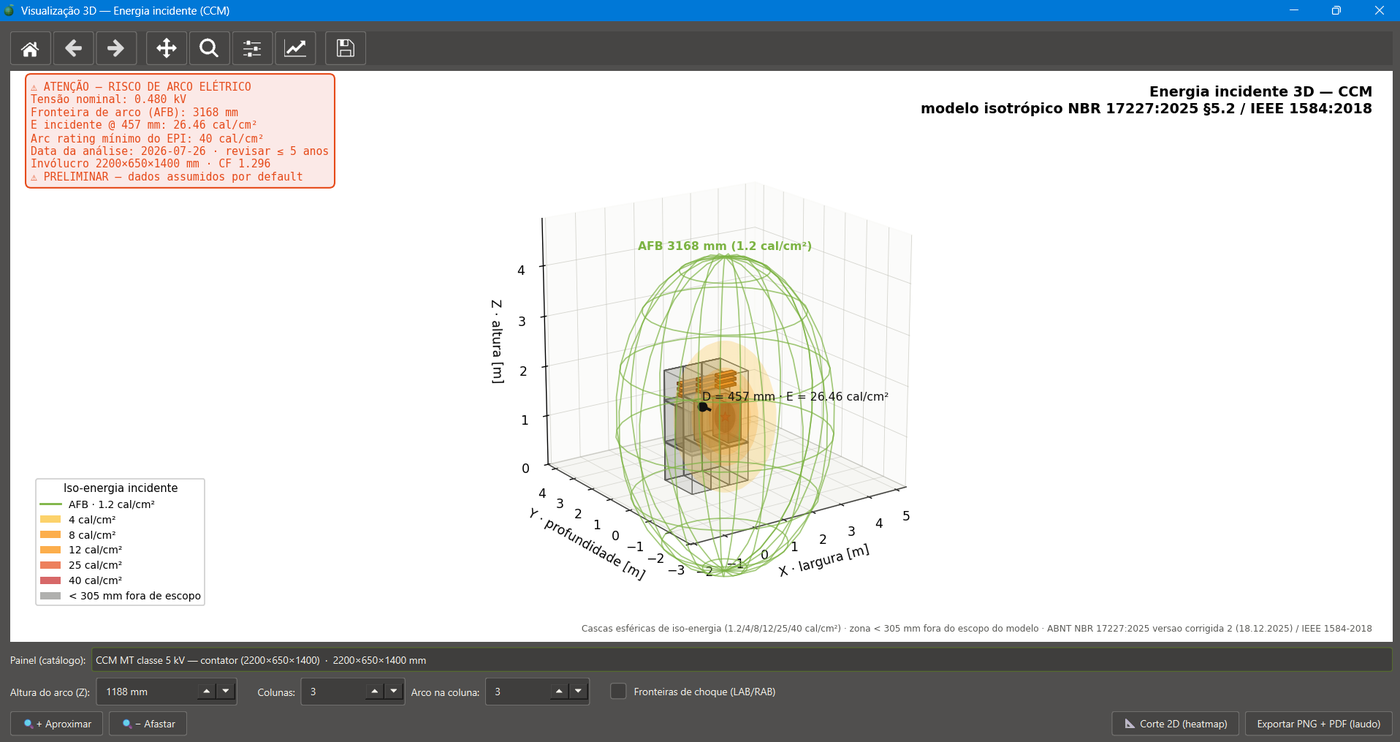
3D arc-flash in Olivas PSS: from modeling the panel to the risk label.
3,168 mm
arc-flash boundary (AFB)
26.46 cal/cm²
incident energy at 457 mm
40 cal/cm²
minimum PPE arc rating
NBR 17227:2025, IEEE 1584:2018 and the classic methods computed side by side — with the divergence between them made explicit, not hidden.
Below 305 mm IEEE 1584 leaves its validity domain. The software flags that zone instead of silently extrapolating — the kind of limit a report has to declare.
Enclosure, arc height, column and correction factor go into the calculation; out come the NFPA 70E / NBR 17227 label and the report with the full calculation trail.
Validated against IEEE 1584 Annex D with a 0.002% deviation.
A module few tools carry
The question that decides the protection is not “does the CT saturate?”, but “does it saturate before or after the relay trips?”. Olivas integrates the flux λ(t) cycle by cycle and shows the margin in milliseconds between the trip point and the onset of saturation.
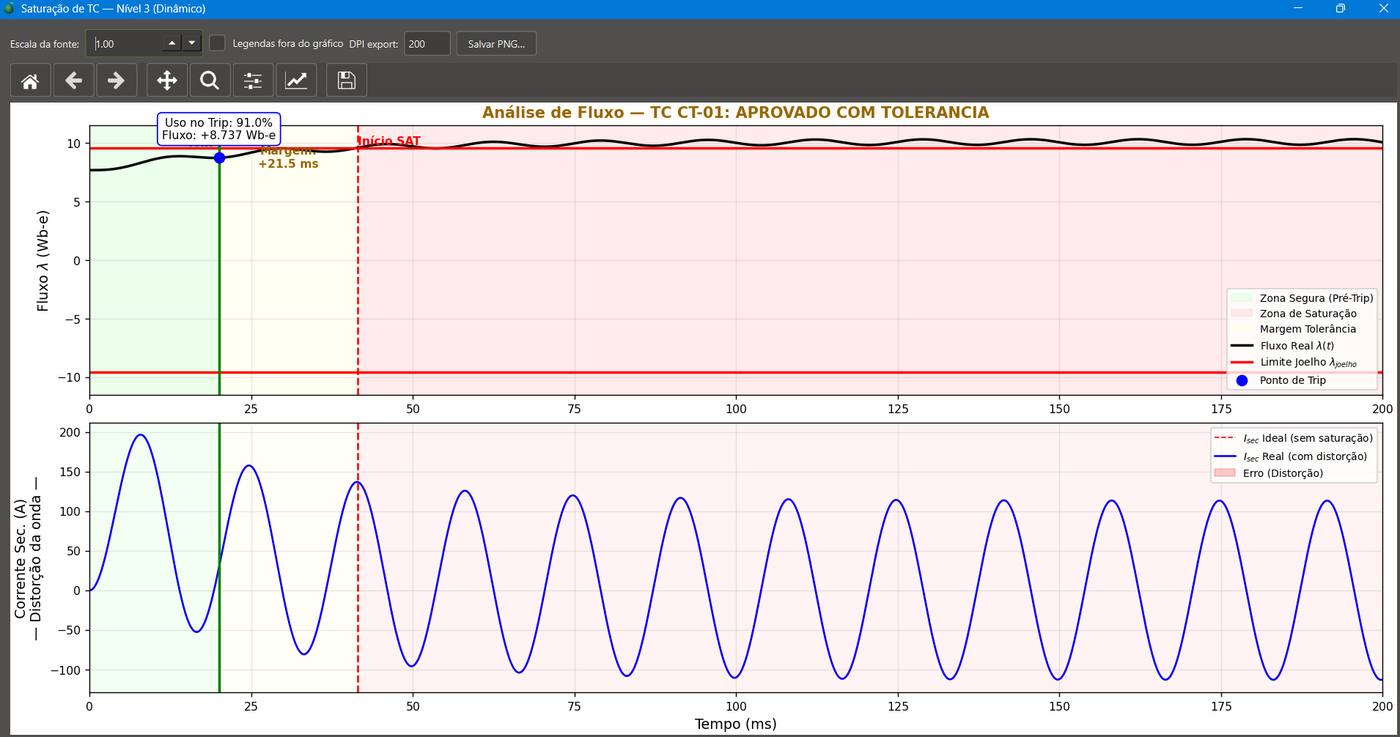
+21.5 ms
margin to the onset of saturation
91%
flux used at the trip instant
λ(t)
integration in the time domain
IEEE C57.13 · IEC 61869-2 — with a verdict per CT, not just the excitation curve.
New module
A grid battery is not one more dispatchable source. The power it delivers depends simultaneously on the state of charge, on distinct charging and discharging efficiencies, on the converter's capability envelope and on the derating that sets in as the SoC approaches its floor. Representing it as a fixed-limit generator yields an optimistic report — and in an island study, optimistic is the report that credits the plant with autonomy it does not have.
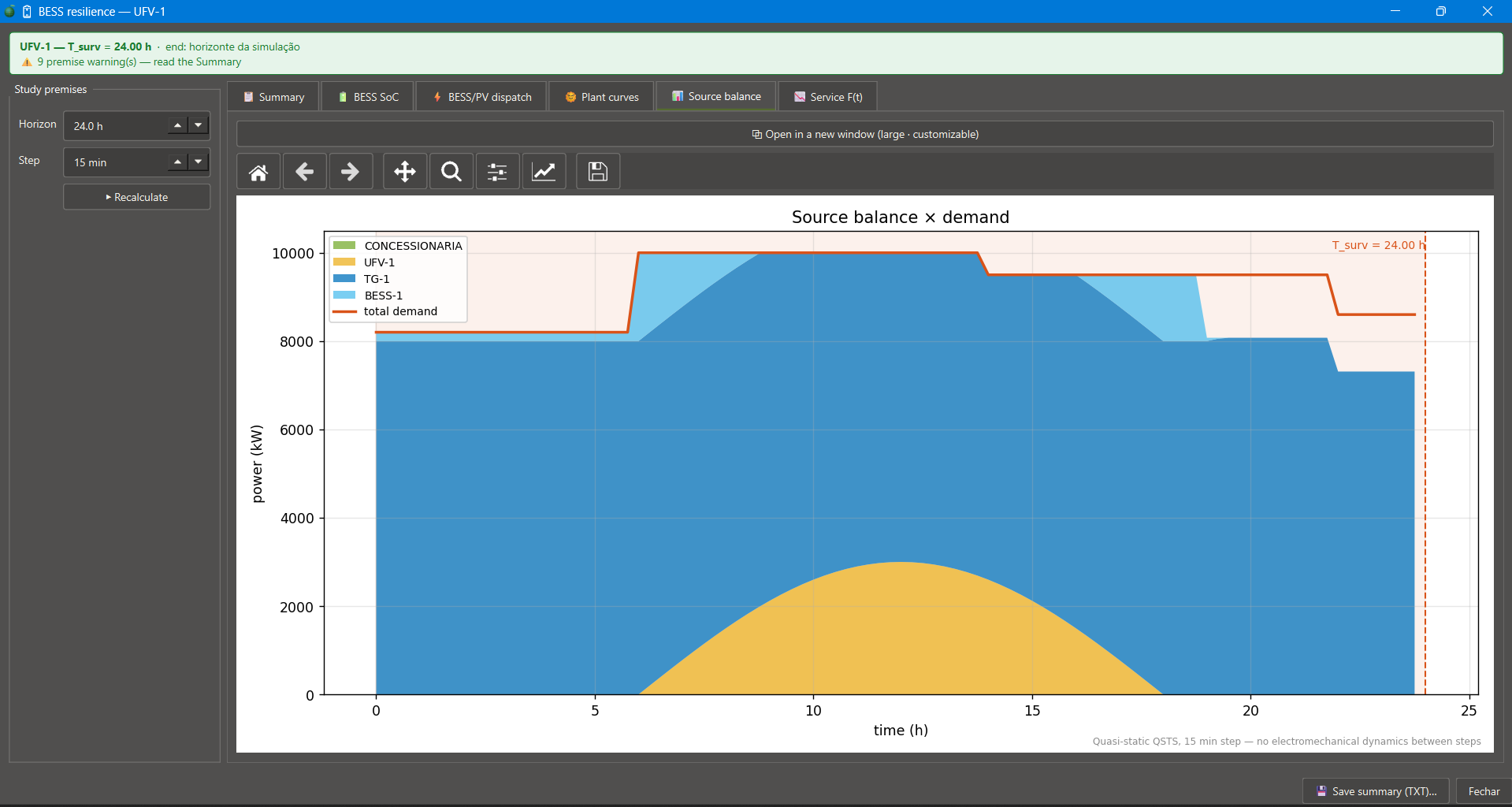
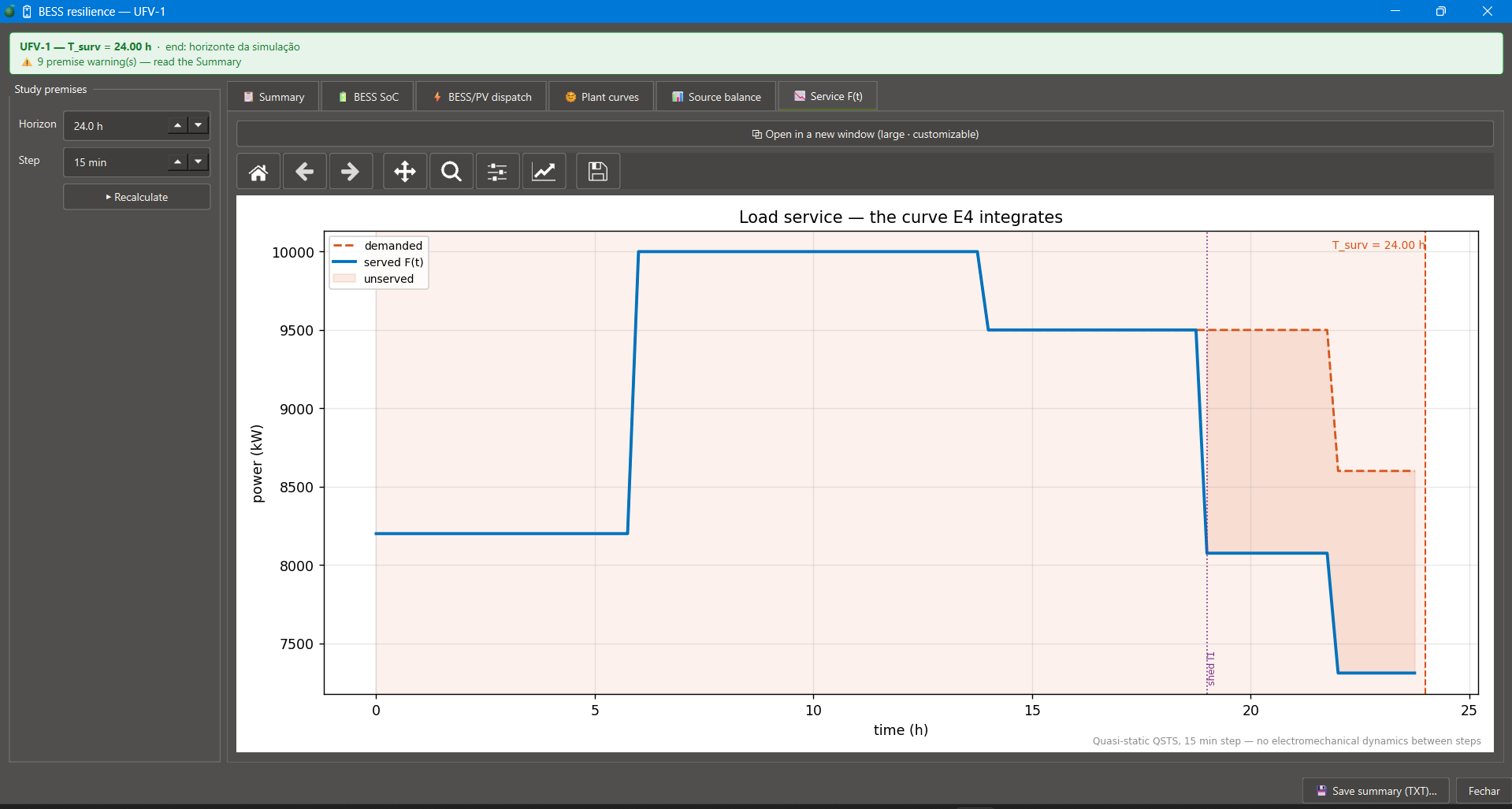
24 h
island survival time (T_surv) in the reference case
800 kW
peak removed by demand limiting over 24 h
0.1 %
maximum energy-balance error, under any strategy
State of charge with asymmetric efficiencies, four-quadrant converter P-Q capability and power limits as a function of SoC, C-rate and temperature — solved together, not in sequence.
The summary lists the premises adopted: which contingency the software selected and why, and where the shedding scheme came from. A declared premise is an auditable premise.
AC grid storage is not the stationary battery bank of the IEEE 485 domain, which remains a separate study with its own sizing method.
Three invariants guaranteed at every step: the SoC never leaves the declared window, the operating point never exceeds the capability and the energy balance closes to within 0.1%.
Plans
Each plan unlocks exactly what fits it; features above your plan remain visible and highlight the upgrade. The Enterprise tier adds the verifiable report, the panel passport and pre-switching analysis (Olivas Inside).
Academic use
Most chosen
Professional use and signed report
Olivas Inside · two editions · all included
Commercial product
Named license with online activation, a token bound to the machine and full issuance history. Each version ships with a dedicated installer and a signed manifest — the client's IT can audit exactly what was installed.
Open the purchase page01
Technical interface with a graphite theme and cream canvas for long working sessions.
02
Online OLV2 commercial activation, bound to the machine ID and a local token.
03
Technical catalog with transformers, motors, LV/MV cables, HV lines, protection, CTs and manufacturers.
04
Study tools for CT saturation, motor starting and equipment withstand.
05
Release pipeline with a SHA256 manifest to avoid mixing old files.
Device catalog
The study uses the curve of the device you are going to specify — not a generic one. That is the difference between coordination that closes on paper and coordination that closes in the field.






Olivas PSS 7X
Dedicated installer, SHA-256 manifest and an update channel inside the app. You know exactly which build is running — and you can prove it in an audit.